
A Shell of Its Former Self
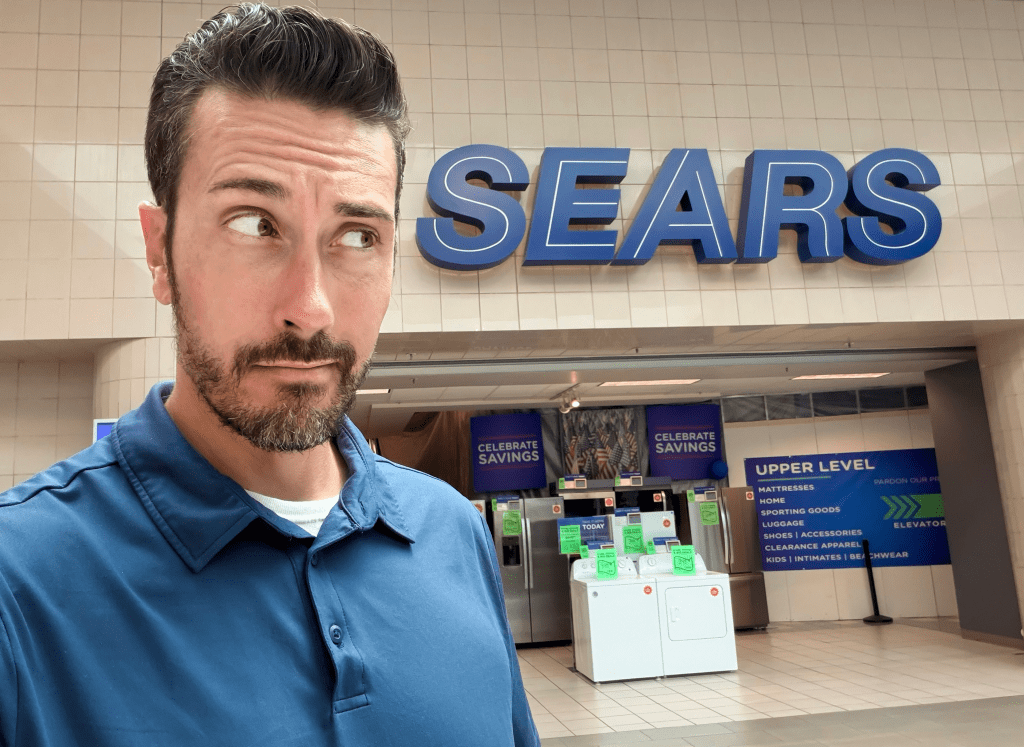
This week I visited one of the five Sears stores left in America.
Have you heard of Sears? If you were investing in the 1960s, 70s, or even the 80s, you almost certainly had. Sears was not just a successful retailer. It was one of the most valuable companies in the country.
Original member of the S&P 500 at its creation in 1957. Largest retailer in the United States for decades. By 1965, Sears sat among the five largest companies in the entire S&P 500, ahead of General Electric.
People considered it too big to fail.
Walking through that store this week, none of that history was visible. It was a shell of what it used to be.
What Actually Happened
The decline did not happen overnight. It happened one competitor at a time.
Walmart. Home Depot. Best Buy. Target. Amazon. Each one chipped away at a piece of what Sears used to own.
| Year | What Happened |
| 1886 | Founded as R.W. Sears Watch Company |
| 1957 | Original member of the S&P 500 at the index’s creation |
| 1965 | Sits among the five largest companies in the S&P 500, ahead of General Electric |
| 1970s-80s | Peak dominance. Sears is the largest retailer in America |
| 1990s-2000s | Walmart, Home Depot, Best Buy, and Target steadily take market share |
| 1999 | Removed from the Dow Jones Industrial Average after 76 years |
| 2005 | Merges with Kmart to form Sears Holdings |
| 2012 | Removed from the S&P 500 after 55 years, replaced by LyondellBasell |
| 2018 | Sears Holdings files for Chapter 11 bankruptcy |
| 2025 | Down to 5 remaining stores nationwide |
Sears held its seat in the S&P 500 for 55 years before losing it. That is longer than most companies ever get. And it still was not enough to survive.
The Number That Actually Matters
Here is the lesson I find fascinating.
Of the 500 companies that made up the original S&P 500 in 1957, only a small fraction are still in the index today. Published research tracking the index puts the number of true survivors at well under 20% of the original list.
The rest were removed through bankruptcy, acquisition, merger, or simply falling behind better-run businesses. Sears is one name on a very long list.
Yesterday’s Sears becomes today’s Apple. Today’s leaders may eventually become tomorrow’s history.
Why This Is an Argument for Index Funds
This is one of the biggest reasons I have always leaned toward broad index fund investing over picking individual stocks.
You do not have to predict whether today’s biggest company will still be a winner in 30 years. Nobody has a perfect track record at that.
The index does the predicting for you, automatically. It is constantly evolving. Underperforming companies get removed. Companies driving the current economy take their place.
You never had to decide to sell Sears. The index did it for you in 2012. You never had to decide to buy Apple, Amazon, or Nvidia before they became giants. The index added them as they earned their place.
That is the quiet strength of passive investing. It is not that indexing guarantees you own the next Apple. It is that it guarantees you will not be stuck holding the next Sears either — not permanently.
The Individual Stock Risk
If you had bought and held Sears stock in 1965 because it was a top-five company, and never touched it again, that decision would have cost you badly by 2018.
Being large today is not a guarantee of being large tomorrow. Being “too big to fail” has failed plenty of companies throughout market history.
An index fund does not ask you to make that call. It removes the underperformer and adds the outperformer as the economy shifts, without you having to time anything.
This is not a case against ever owning individual stocks. It is a case for making sure your core, long-term holdings are not a bet on any single company staying dominant forever.
A Question Worth Sitting With
Which of today’s biggest companies do you think people will be shocked to see disappear from the S&P 500 over the next 30 years?
It is an uncomfortable question. Every generation has companies that feel permanent. Sears felt permanent in 1965. It is worth remembering that the next time a stock feels like a sure thing.
Drop your guess in the comments. I want to know what you think.
📊 Start Investing the Way I Actually Do
I invest in broad market index funds, not individual stock picks. See exactly how that works and what it has returned in my $5-a-day investing challenge.
► Read: I Invested $5 a Day in the S&P 500
The Bottom Line
Sears was not a failing company run by careless people. It was one of the most dominant businesses in American history, and it still lost to time and changing competition.
That is not a reason to avoid the stock market. It is a reason to avoid betting your entire future on any single company inside it.
An index fund does not need you to guess which company survives the next 30 years. It just needs you to keep showing up.